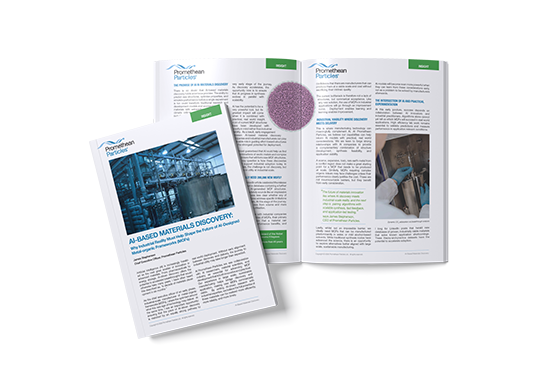
Promethean Particles’ chief executive officer, James Stephenson, has written a new Insight article exploring how Artificial Intelligence (AI) is reshaping the future of materials discovery and why industrial collaboration is essential to turning rapid digital breakthroughs into real-world solutions.
In the piece, James highlights the enormous potential of AI to accelerate the discovery of metal-organic frameworks (MOFs), a class of advanced materials with promising applications in areas such as carbon capture, water harvesting, and biogas upgrading. AI can now model and predict thousands of new structures at unprecedented speed, offering what many describe as “decades of materials development in six months.”
However, he emphasises that the next major breakthrough will not come from generating more hypothetical structures, but from ensuring the most promising candidates can be manufactured reliably, sustainably, and at scale. Industrial viability including raw material availability, cost, safety, supply chain stability, and scalable synthesis routes, must move earlier in the discovery process, becoming design inputs rather than late-stage hurdles.
“The future of materials innovation lies where AI discovery meets industrial-scale reality, and the next step is pairing algorithms with scalable synthesis, fast feedback, and application-led testing,” says James Stephenson, chief executive officer of Promethean Particles.
The article argues that AI and industry are natural partners. AI excels at exploration and prediction, while manufacturers like Promethean Particles bring practical expertise in synthesis feasibility, continuous-flow production, and application testing. By feeding real-world data back into AI models, the discovery-to-deployment cycle becomes faster, more focused, and far more impactful.
James outlines how Promethean Particles’ rapid synthesis platforms, scalable manufacturing technologies, and performance-testing capabilities — from TGA and dynamic breakthrough analysis to full-cycle carbon capture trials, can help AI innovators validate materials quickly and guide their models toward structures that are not only novel but deployable.
Ultimately, the article calls for deeper collaboration between AI developers and industrial MOF manufacturers. The goal is a more efficient, data-rich discovery ecosystem where digital prediction and practical experimentation reinforce each other — accelerating the path from idea to meaningful industrial impact.