
Leading Application for MOFs
Biogas Upgrading: From Waste to Renewable Energy
What is Biogas Upgrading?
Think of it as a refining step: it takes a good, renewable fuel and transforms it into a high-value, pipeline-ready energy product.
Why is Upgrading Biogas So Important?
Upgrading is the key that unlocks the commercial and environmental value of biogas. Without it, biogas use is limited.
- Injection into the Gas Grid: Biomethane can be fed directly into the national natural gas grid, decarbonizing our heat supply.
- Bio-CNG & Bio-LNG: It can be compressed (Bio-CNG) or liquefied (Bio-LNG) for use as a clean, renewable transport fuel for vehicles and shipping.
- High-Efficiency Power Generation: Biomethane can be used in high-efficiency gas engines or turbines with lower emissions.
- Carbon Dioxide (CO2) Capture: The separated CO2 can often be captured for use in industrial applications, creating a circular economy.
Core Technologies in Biogas Upgrading
Several technologies are employed to separate CO2 from methane, each with its own advantages. The choice often depends on factors like plant size, desired purity, and operational costs.
Water Scrubbing
This method uses the higher solubility of CO2 in water under pressure to wash it out of the gas stream. It’s a robust and well-understood technology.
Pressure Swing Adsorption (PSA)
PSA uses specialized adsorbent materials that selectively capture CO2, nitrogen, and oxygen molecules onto their surface, allowing methane to pass through. The adsorbents are then regenerated by releasing the pressure.
Membrane Separation
This process relies on semi-permeable membranes that allow smaller molecules like CO2 to pass through faster than larger methane molecules, effectively separating them under pressure.
Chemical Scrubbing
Using a chemical solvent (often an amine solution), CO2 is chemically absorbed. The solvent is then heated in a separate column to release the captured CO2 and be reused.
The Role of Advanced Adsorbents
At the heart of technologies like Pressure Swing Adsorption (PSA) are the adsorbents. These highly engineered porous materials are the workhorses of the separation process. Their performance—dictated by surface area, pore structure, and selectivity—directly impacts the efficiency, purity, and cost-effectiveness of the entire upgrading plant.
Superior adsorbents lead to higher methane recovery, lower energy consumption, and a more consistent, high-purity biomethane product.
Pioneering the Future of Biogas Upgrading
While the principles of biogas upgrading are established, the quest for greater efficiency and lower costs continues. The future lies in developing next-generation materials and integrated processes.
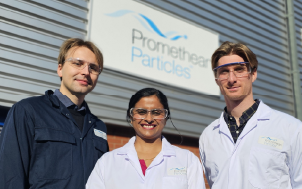
At Promethean Particles, we are at the forefront of this innovation. Our research is dedicated to creating advanced adsorbents and catalytic solutions that make biogas upgrading more efficient and accessible than ever before. We partner with plant developers and technology providers to push the boundaries of what’s possible in renewable gas.
Contact our team of experts to learn how advanced material science can optimize your biogas upgrading project.
BIOGAS UPGRADING NEWS

Promethean Particles Joins the World Biogas Association
Promethean Particles, a world-leader in the manufacture of industrial-scale, high quality, cost-effective...
Ready to discuss how Promethean Particles can help you with your next MOF-based challenge? Contact us to learn more.